Laser vs LED face masks: what actually changes the result.
Almost every red light therapy mask on the market uses LEDs. A small number use VCSEL laser diodes. The marketing language is nearly identical, so the difference is easy to miss — but the two deliver light in measurably different ways. Here is what separates them, and how to read a spec sheet so you can tell which you are buying.

The short version
LEDs emit incoherent light across a fairly wide band and in a wide cone. Laser diodes emit coherent, narrow-band light in a tight beam. Same wavelength label on the box, different amount of usable energy arriving at the depth you care about. Two numbers explain most of it: how much of the output actually sits at the target wavelength, and how evenly that output is spread across your face.
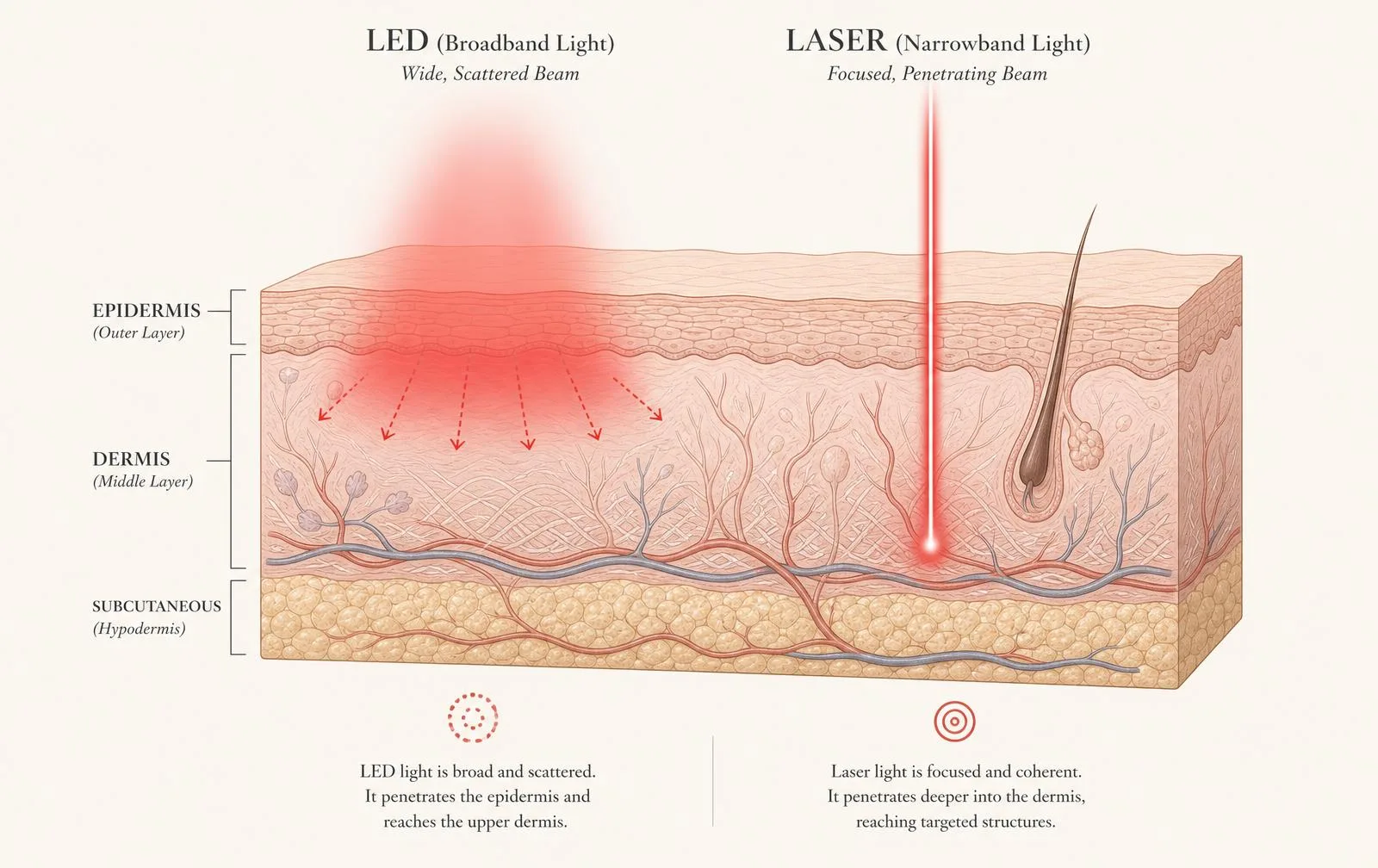
1. Penetration depth
Wavelength sets the ceiling on depth: 660 nm interacts mostly with the epidermis, 850 nm reaches the dermis and subcutaneous tissue, and 1064 nm reaches deepest. But wavelength alone does not get light there. Tissue scatters light, so what reaches a given depth depends on how much intensity arrived at the surface and how directional it was. Coherent, low-divergence laser output loses less on the way in, which means a laser mask and an LED mask labelled with the same wavelength do not deliver the same dose at depth.
This is also why 1064 nm is rare on consumer masks. It is hard to produce at useful intensity with LEDs, so most devices stop at 630–850 nm.
2. Irradiance uniformity
Irradiance — power per unit area, in mW/cm² — is the number that decides how long a session needs to be. Dose is irradiance multiplied by time, so a mask at half the irradiance needs roughly twice the session to deliver the same energy.
Uniformity matters just as much. Because LEDs radiate in a wide cone and fall off quickly with distance, an LED array is brightest directly beneath each diode and dimmest between them. On a rigid mask that sits away from the face, that variation grows. Laser emitters keep their energy in a narrower beam, so the field across the mask is flatter — the area under your cheekbone receives a dose closer to the area directly under an emitter. An average irradiance figure hides this; ask about coverage, not just peak output.
3. Session time and consistency
Higher, flatter irradiance means shorter sessions. That sounds like a convenience point, but it is really an adherence point: the strongest predictor of results from any light therapy device is whether you keep using it. A 10-minute session survives a real evening routine in a way a 30-minute one often does not.
Side by side
| Spec | VCSEL laser mask | Standard LED mask |
|---|---|---|
| Light source | VCSEL laser diodes — coherent, narrow-band emission | Light-emitting diodes — incoherent, broader emission band |
| Spectral width | Typically a few nanometres around the target wavelength | Often ±20–30 nm, so part of the output sits off-target |
| Beam behaviour | Narrow divergence — energy stays where it is aimed | Wide divergence — output spreads and drops off with distance |
| Irradiance at the skin | Higher and more consistent across the mask surface | Usually lower, and highest directly under each diode |
| Coverage uniformity | Even field; fewer bright spots and dead zones | Dot pattern — coverage depends on diode spacing |
| Effective depth | Deeper reach for the same wavelength at higher irradiance | Shallower, more surface-weighted delivery |
| Session length | Shorter sessions for the same delivered dose | Longer sessions to reach a comparable dose |
| Cost | More expensive to manufacture | Inexpensive — the reason most masks use it |
When an LED mask is the right buy
Honestly: often. If your goal is surface-level tone and texture, you are comfortable with longer sessions, and you want to spend a few hundred dollars rather than several, a well-made LED mask with published irradiance figures is a reasonable device. Laser matters most when you want deeper wavelengths, even coverage, and short sessions — and are willing to pay for the hardware that does it.
How to read a spec sheet
- Light source. "LED" and "laser" are different hardware. "Laser-like", "laser-grade", or "medical-grade" are marketing terms, not sources.
- Wavelengths in nanometres. Named colours without numbers tell you nothing about depth.
- Irradiance in mW/cm². If it is missing, you cannot calculate dose — and dose is the whole mechanism.
- Session length. Cross-check it against irradiance; a long session usually signals a low figure.
- Fit. A flexible mask that stays close to the skin loses less intensity than a rigid shell held away from it.
Where the G11 sits
The Dermé G11 is a laser mask, not an LED one. It uses true VCSEL diodes at three wavelengths and publishes its irradiance so you can check the dose maths yourself.
Common questions
Is a laser mask stronger than an LED mask?
At the skin, usually yes. Strength in light therapy is irradiance (mW/cm²) held over time, and coherent laser output holds a higher, flatter irradiance across the mask than a comparable LED array. That is why laser sessions tend to be shorter for the same delivered dose.
Does 1064 nm matter on a home device?
1064 nm is the wavelength most associated with deeper tissue reach, and it is rare on consumer masks because it is difficult to deliver with LEDs at useful intensity. On the G11 it sits alongside 660 nm and 850 nm so the same session covers surface and depth.
Are more diodes always better?
No. Diode count only matters relative to output and spacing. A mask with hundreds of weak LEDs can deliver less usable energy than a laser mask with fewer, better-collimated emitters. Read irradiance and wavelength before you read diode count.
Is a laser mask safe to use at home?
The G11 is a cosmetic and wellness device operating at non-ablative intensities, with supplied eye protection and a fixed session length. It is not a medical device and is not intended to diagnose, treat, cure, or prevent any disease. Follow the included guidance and see our safety page.
Dermé devices are cosmetic and wellness products, not medical devices. Nothing here is intended to diagnose, treat, cure, or prevent any disease. See our safety information.