660 vs 850 vs 1064 nm: which wavelength does what.
Wavelength is the single most useful number on a light therapy spec sheet, and the one most often replaced with a colour name. "Red light" spans devices that behave very differently. Here is what each of the three wavelengths in the G11 does, and how to compare them honestly.
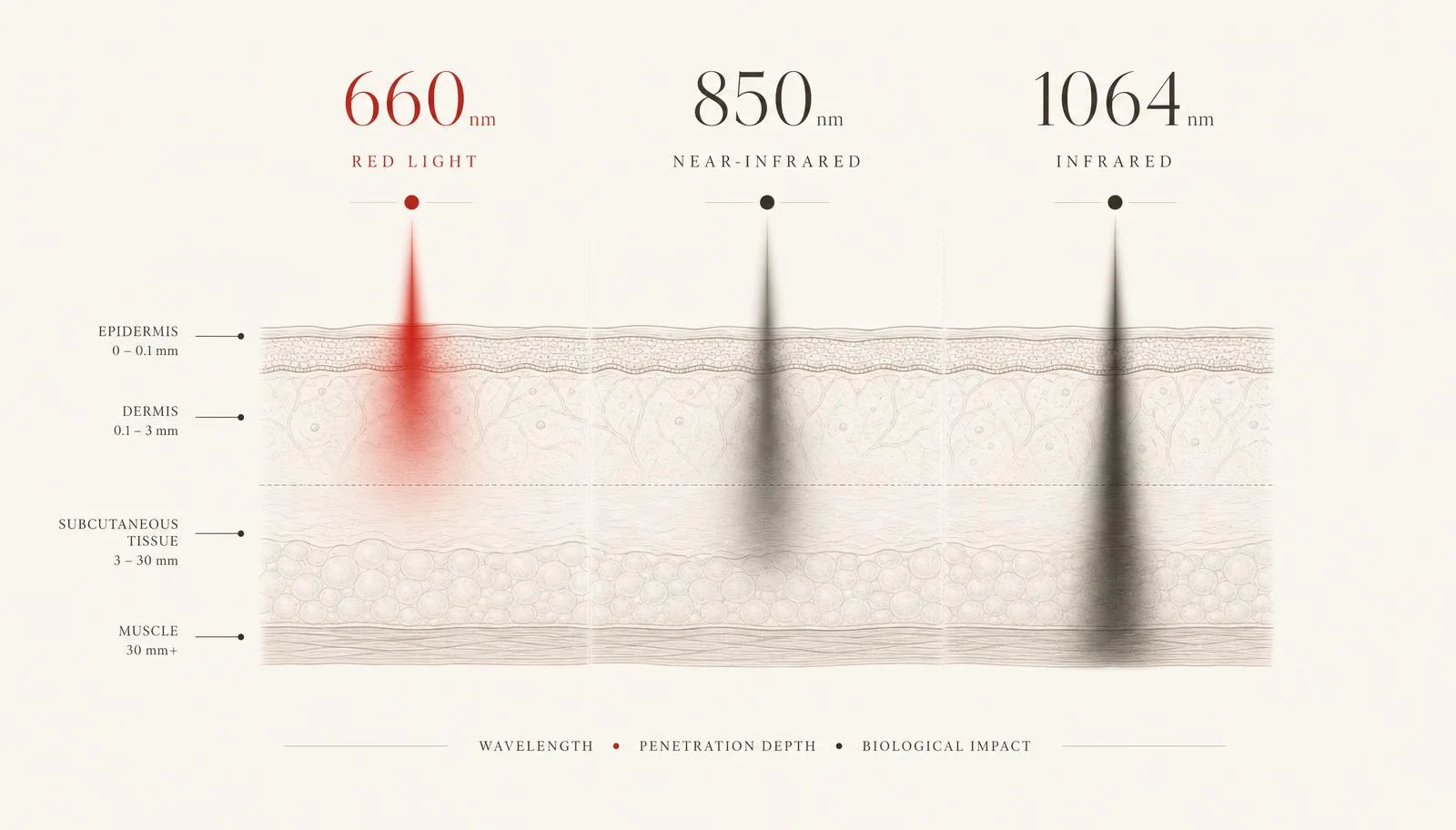
The short version
Longer wavelengths scatter less in tissue and therefore travel further. 660 nm works at the surface, 850 nm reaches the dermis and below, and 1064 nm reaches deepest. None of them substitutes for another, and none of them reaches anywhere useful without enough irradiance behind it.
Why depth follows wavelength
Skin absorbs and scatters light unevenly. Shorter visible wavelengths are scattered strongly and absorbed heavily by melanin and haemoglobin, so most of that energy is spent near the surface. As wavelength increases into the near-infrared, scattering and absorption both fall across a window roughly from 650 to 1100 nm — the reason nearly every therapeutic device lives inside it. Beyond that window, water absorption climbs again and the light stops travelling.
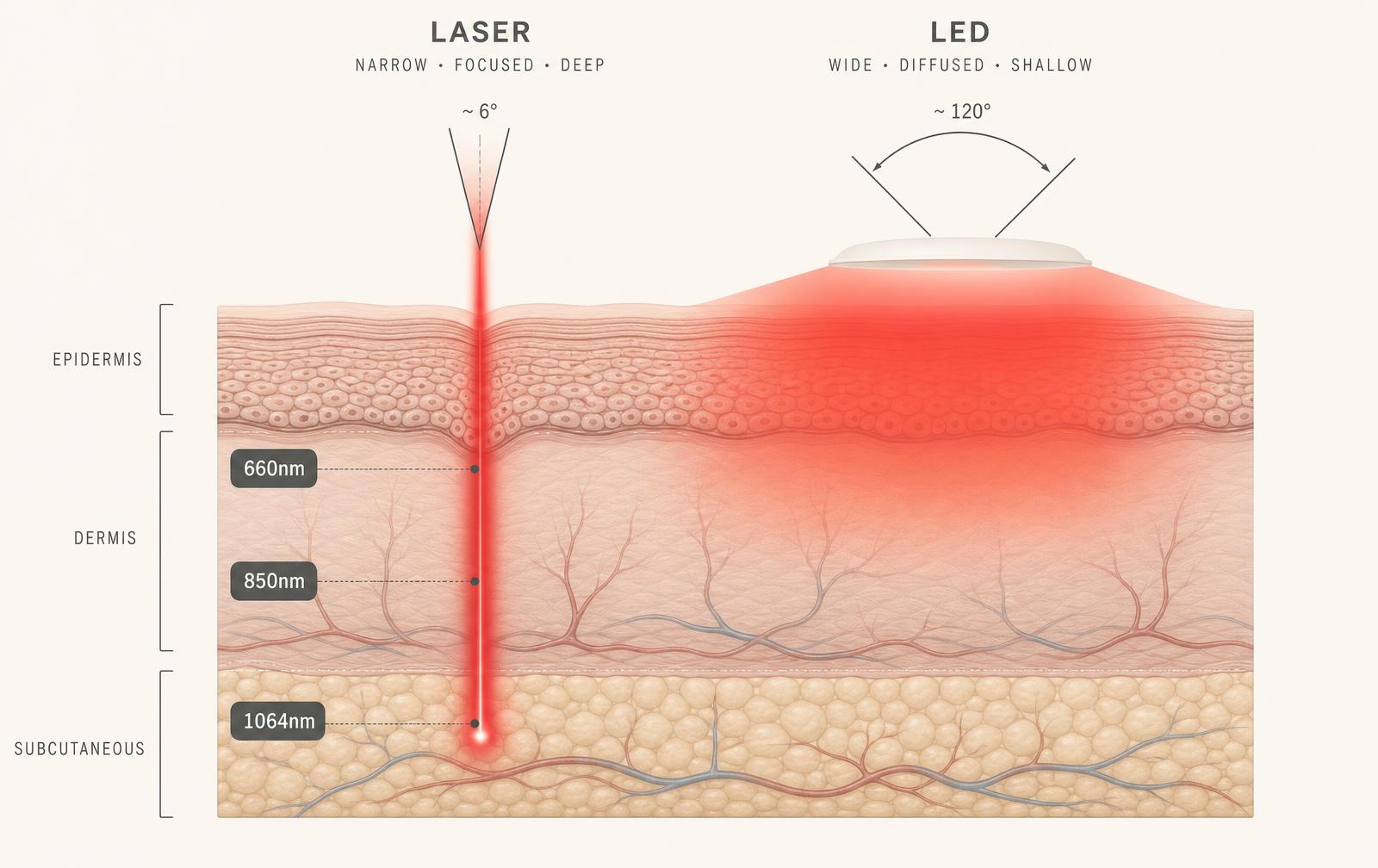
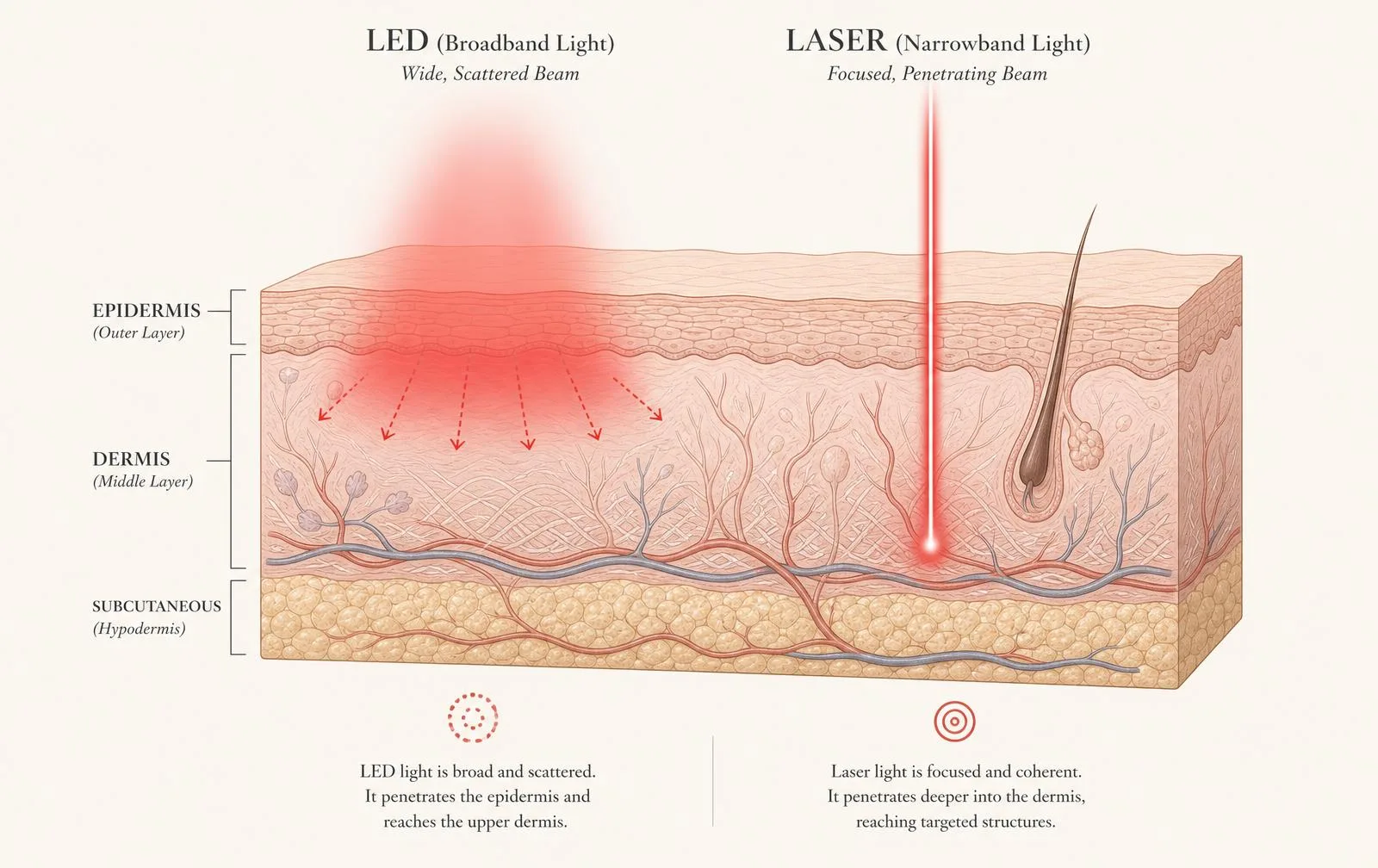
Depth is a ceiling, not a guarantee. How much energy actually arrives depends on the irradiance at the skin and how directional the beam is, which is why two devices labelled 850 nm can deliver very different doses at the same depth.
| Wavelength | Band | Reach | Generally associated with | To the eye |
|---|---|---|---|---|
| 660 nm | Visible red | Surface — epidermis and upper dermis | Generally associated with skin tone, surface texture and visible glow | Bright red to the eye |
| 850 nm | Near-infrared | Deeper — dermis and subcutaneous tissue | Generally associated with deeper tissue support and recovery | Barely visible — a faint dull red |
| 1064 nm | Deep near-infrared | Deepest reach of the three | The wavelength most used in clinical laser settings for depth | Invisible |
Brightness is a bad proxy for power
660 nm looks intense because your eye is sensitive to it. 1064 nm is invisible. A device that looks dimmer can be delivering more energy at depth, and a device that floods the room with red light can be delivering very little. Judge by published wavelengths and irradiance in mW/cm², not by glow.
How to compare two devices
- Named wavelengths in nm. "Red and infrared" without numbers is not a spec.
- Irradiance per wavelength if published. A wavelength present at token intensity is a bullet point, not a treatment.
- Simultaneous or sequential. Three wavelengths in one session is different from three separate modes.
- Source type. LEDs emit across a ±20–30 nm band, so part of the output sits off the stated figure; laser diodes are narrow-band.

Where the G11 sits
The Dermé G11 emits all three — 660 nm, 850 nm and 1064 nm — from true VCSEL laser diodes, 90 lasers across 270 chips, at a published 48–60 mW/cm² in a session of about 10 minutes.
Common questions
Is a longer wavelength always better?
No. Depth is not a quality score — it is a targeting choice. Tone and texture concerns sit in the surface layers, where 660 nm does its work. Firmness and recovery concerns sit deeper. A device covering only one band covers only part of the picture.
Why is 1064 nm rare on home masks?
It is hard to produce at useful intensity with LEDs, and it is invisible, so it offers no reassuring glow to market with. Delivering it usefully generally means laser diodes, which cost more to build.
Can I just run a 660 nm device three times as long?
No. Time changes dose, not wavelength. Extra minutes at 660 nm never produce 850 nm or 1064 nm light, so they cannot reach the depths those wavelengths reach.
Do the three wavelengths need to run together?
They do not have to, but running them in one session is simpler and shorter than three separate treatments. The G11 emits 660, 850 and 1064 nm in a single roughly 10-minute session.
What about blue light for acne?
Blue light around 415 nm is a different mechanism aimed at surface bacteria and does not penetrate meaningfully. It is not part of the G11, and it is not interchangeable with red or near-infrared light.
Dermé devices are cosmetic and wellness products, not medical devices. Nothing here is intended to diagnose, treat, cure, or prevent any disease. See our safety information.